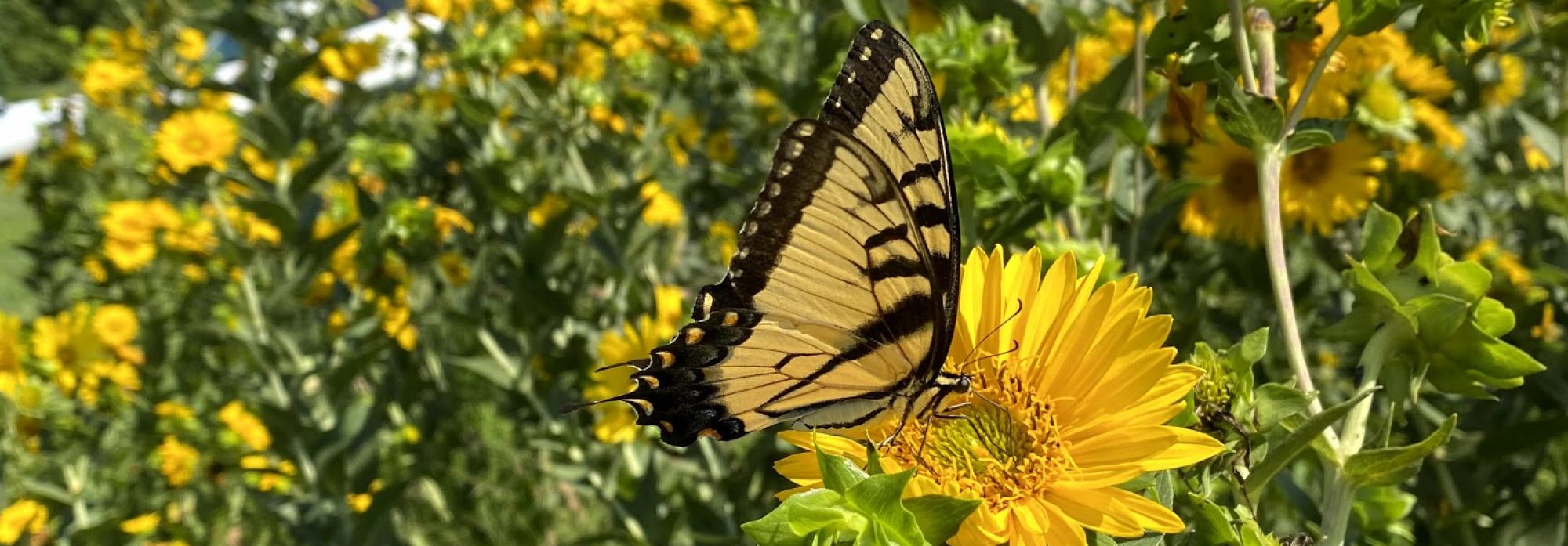
We work mostly with plants and insects, and our projects are united by a focus on how land-use and land-cover change influence biodiversity and ecosystem function. Most of our research is field- and lab/greenhouse-based, but we also incorporate modeling (GIS, model fitting, simulations) and analytical (stable isotope and DNA sequencing) approaches into our research. Our research links empirically-derived data with basic ecological theory and we use this basic knowledge to better manage insects and plants for restoration and sustainable agriculture. Below is some information about our current projects.
1. Plant-insect interactions across spatial scales
 Environmental variability can affect the strength of plant-insect interactions and these patterns change with spatial scale. For instance, at very small spatial scales (< 2 m2), environmental conditions immediately surrounding a plant can influences damage through variability in herbivore growth, host-plant selection, and feeding behavior. At medium spatial scales (i.e., landscape scale), environmental variability due landscape composition influences the strength of tri-trophic interactions by affecting the regional species pool of arthropods and prey-tracking ability of predators for prey. Finally, at very large spatial scales (i.e., continent scale), environmental variability due to location along a latitudinal gradient influences plant damage and resistance due to differences in herbivore community structure, range, and distribution. Understanding how plant-insect interactions varies across spatial gradients has implications for predicting how disturbances such as land-use change or climate change might impact insect and plant biodiversity patterns.
Relevant studies:
Kim, T. N. 2017. Neighborhood composition influences damage to plants and four mechanisms of associational resistance and susceptibility. PlosOne 12(5): e0176499.
Liere, H., T.N. Kim, B.P. Werling, T.D. Meehan, D.A. Landis, C. Gratton. 2015. Trophic cascades in agricultural landscapes: indirect effects of landscape composition on crop yield. Ecological Applications. 25: 652–661.
Kim, T.N. 2014. Plant damage and herbivore performance change with latitude for two old-field plant species, but rarely as predicted. Oikos 123: 886-896.
2. Disturbance effects on biodiversity

Natural and anthropogenic disturbances can influence biodiversity and ecosystem function. Because disturbances can occur at both localized and landscape scales, it is unclear whether these disturbances can have additive or multiplicative effects for plant and insect communities. In grasslands, we examined how annual harvesting and bison/cattle grazing (localized disturbances) affected predatory arthropod communities and the ecological functions they perform (natural biological control). We also examined whether land-use change (a landscape-scale disturbance) could accentuate or mitigate the potentially negative effects of disturbance for arthropod communities. We found that disturbances within perennial grasslands and land-use change had variable effects on the abundances of different functional groups, alpha and beta diversity, and predator diet breadth. Despite these changes in predator community structure and feeding behavior, there were no disturbance effects on pest suppression services suggesting compensation in pest suppression function by unaffected arthropod groups. These results suggest that disturbances occurring at different spatial scales (localized versus landscape scales) can interact with one another to have unpredictable, non-additive effects on arthropod biodiversity and ecosystem function.
Relevant studies:
Kim, T. N., Fox, A. F., Wills, B. D., Meehan, T. M, Landis, D. A., and C. Gratton. 2017. Annual harvesting of biofuel grasslands has mixed effects on natural enemy communities and no effect on biocontrol services. Journal of Applied Ecology. https://doi.org/10.1111/1365-2664.12901
Kim, T. N., *Bartel, S., and C. Gratton. 2019. Grassland harvesting alters ant community trophic structure: an isotopic study in tallgrass prairies. Ecology and Evolution. 9 (17): 9815-9826. https://doi.org/10.1002/ece3.5523
Kim, T. N., Bukhman, Y. V., Jusino, M. A., Scully, E. D., Spiesman, B. J., and Gratton, C. 2022. Using High-Throughput Amplicon Sequencing to Determine Diet of Generalist Lady Beetles in Agricultural Landscapes. Biological Control 170: 104920. https://doi.org/10.1016/j.biocontrol.2022.104920
3. Spatio-temporal effects of resource availability on insect population dynamics

We are investigating the relative importance of spatial and temporal heterogeneity in resource availability on population dynamics of consumers. Landscape theory has focused mainly on how the spatial arrangement of patches (i.e., amount and configuration) affect population dynamics of consumers but the importance of temporal variability in resource availability has been largely overlooked. Using three approaches, we are examining how the spatio-temporal availability of food resources affects mobile consumer populations. (1) In a field study in WI, we are examining how the phenology of prey resources affects the physiology and performance of predatory insects such as lady beetles and ecosystem function (e.g. prey consumption rates). (2) Using a controlled lab feeding experiment, we are investigating how temporal variability in prey type and amount influence the fitness and behavior of lady beetles, and (3) using a lab microcosm with bean beetles (Callosobruchus maculatus), we are testing how the spatial arrangement and timing of available resources affect populations dynamics of consumers.
Relevant papers:
Quellhorst, H, Kim, T. N, Zhu, K. Y, and W. R. Morrison III. 2023. Short-term spatial dispersion patterns between the larger grain borer and the maize weevil in grain columns with implications for management of stored maize. Environmental Entomology. nvad111. https://doi.org/10.1093/ee/nvad111
Iluliano, B. Gratton, C. Kim, T. N. and B. J. Spiesman. 2024. Semi-natural habitat, but not aphid amount or continuity, predicts lady beetle abundance across agricultural landscapes. Ecological Applications. 2024: 00:1-13. https://doi.org/10.1111/1365-2664.14698
Stowe, H., Michaud, J.P., and T. N. Kim. 2022. Resource amount and discontinuity influence flight and reproduction in Hippodamia convergens (Coleoptera: Coccinellidae). Ecosphere. 13:e4250. https://doi.org/10.1002/ecs2.4250
4. Benefits of regenerative agricultural practices for biological control in rural and urban food systems

Chemical insecticides are a widely used component of pest management in crops however, many insecticides can have unintended non-target effects on beneficial organisms such as natural enemies, pollinators, and resistance to insecticides is an ever-present concern that can severely limit their effectiveness in the long run. One way to mitigate the negative impact of insecticides on wildlife and humans is to increase crop/habitat diversity through the use of conservation border strips or cover crops to improve ecosystem services such as pollination, pest suppression, soil health, and water quality. I am interested the ecological and socio-economic benefits of these practices for pest management and sustainable agriculture in both urban and rural food systems. Urban food production is a growing area of concern and important for food security, yet proper pest and pollinator management in these systems are less well studied compared to rural systems. More experimentation on sustainable agricultural practices in small spaces is needed, especially since urban farming practices seldom use chemical control of pests.
Relevant papers:
Anderson, M. A., R. Harman, and T. N. Kim. 2024. Ground beetle movement is deterred by habitat edges: a mark-release-recapture study on the effectiveness of border crops in agricultural landscapes. Journal of Insect Science. 24 (3): 24. https://doi.org/10.1093/jisesa/ieae062
Harman, R., and T. N. Kim. 2024. Differentiating spillover: an examination of cross-habitat movement in ecology. Proceedings of the Royal Society B: Biological Sciences. https://royalsocietypublishing.org/doi/10.1098/rspb.2023.2707

 The Insect Ecology Lab @ Kansas State University